


Experts Debate Why AP Scores Have Soared
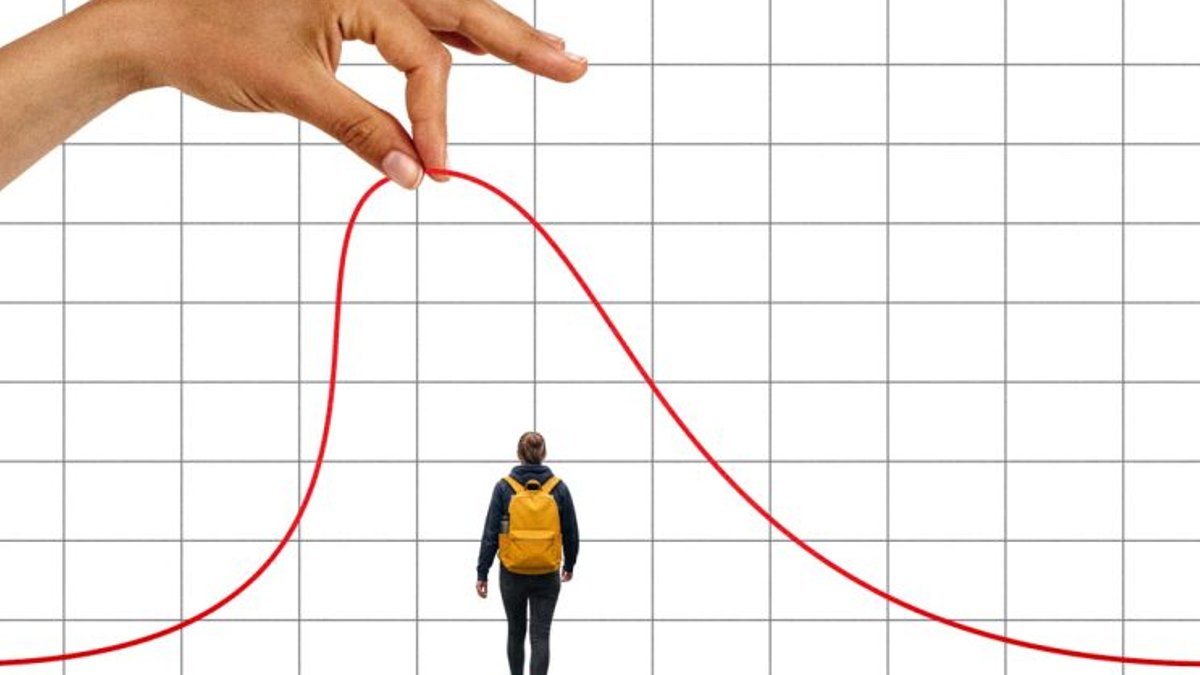
Advanced Placement test scores have climbed sharply in recent years, a trend that has sparked debate over whether the exams have been made easier to pass. The increases, measured on some of the program’s most popular assessments, were as significant as they were unexpected. In AP Chemistry, the share of students scoring a 3, 4 or 5 increased from 54% in 2022 to 75.1% in 2023. In AP United States Government and Politics, that proportion grew even more, from 49.2% to 73%. By one estimate, roughly 100,000 more students hit the passing threshold on AP U.S. History in 2024 than in 2023.
A New Scoring System
The change came after the College Board, the nonprofit organization that owns and administers the AP program, adopted a new scoring methodology intended to tamp down volatility in results. The organization’s leadership said the new procedures brought their standards into better alignment with those of universities themselves, making the AP a more reliable indicator of students’ readiness for college-level work. Since scores of 3 or above are generally accepted for college credit, there needs to be a close equivalency between high ratings on the 42 AP subject tests and what is expected by postsecondary institutions.
Trevor Packer, the College Board’s senior vice president for AP and instruction, rejected that characterization. Passing rates have risen precipitously because the old grading process, reliant on small panels of college instructors, dramatically understated high schoolers’ actual readiness for college, he said. Prior panels had established artificially stringent standards that produced pass rates well below the historical AP standard. For a number of tests, Packer wrote in an email, “prior panels had established artificially stringent standards that produced pass rates well below the historical AP standard.”
This tension highlights a broader tension in education policy: if a standardized test is designed to be an objective measure of student ability, but its results fluctuate wildly based on administrative changes, the test loses its utility as a comparison tool. When a set of exams administered by a private nonprofit shows a massive, statistically unlikely rise in pass rates across nearly every subject at the same time, it forces observers to choose between two difficult explanations: either American students have suddenly become significantly more competent in every field, or the metrics used to measure them have shifted. The College Board argues the latter, while skeptics suspect the former.
Tom Loveless, a veteran K–12 researcher who formerly headed the Brookings Institution’s Brown Center on Education Policy, said the upsurge in AP grading is particularly incongruous with the results of virtually all other standardized testing from the last half-decade, which have shown significant drops in academic achievement coinciding with the emergence of COVID-19 and subsequent closure of schools to in-person learning. “They started this [change in scoring] during the pandemic, and no one in their right mind thinks the scores went up during the pandemic,” Loveless said. “Yet the AP tests are defying what every other test is telling us.”
Peterson’s analysis, based on the College Board’s publicly available scores on each subject test, shows that the phenomenon produced startling effects immediately. Student grades across a selection of AP’s most commonly requested tests — Biology, Chemistry, English Language and Composition, English Literature and Composition, Human Geography, U.S. Government and Politics, U.S. History, World History and Psychology — leapt at both the middle and top of the distribution.
The fraction of students rated 3 or higher in those subjects rose from 52% in 2021 to 71% in 2025, while those scoring a 4 or a 5 increased from 28% to 45%. The progress was not obviously the consequence of a more selective pool of participants; in fact, the total number of test takers grew by over 10% during those four years.
Related: Arkansas schools cut costs with electric buses
Transparency Concerns
The sharp ascent accompanied a switch to novel grading criteria called “evidence-based standard setting,” which incorporate input from hundreds of college faculty members about the performance expectations for their undergraduate courses. In the aftermath of that changeover, far more high schoolers were deemed capable of passing such courses than in years prior.
Packer, who has led AP for over 20 years, vigorously defends what critics call the “Great Recalibration” as a necessary step to smooth out inconsistencies in scoring that had plagued the program. In a 2024 interview, he said the boost to scores under EBSS was actually much smaller than the annual changes generated by the earlier system — citing as an example a group of biology teachers whose 2013 update “subjectively reduced” the number of students earning 5s by approximately three-quarters.
That example comes with a caveat, however: Far from a sudden jolt, the 2013 compression in biology grades followed an overhaul to the course curriculum that was previewed more than two years in advance. At the time, Packer himself announced that university professors considered the new exam “the gold standard of college-level Biology.” In an email, College Board spokeswoman Sara Sympson said that the biology panel had erred in aligning their cut scores (the minimum score to attain a given mark, such as a 3) with the course’s new content and expectations.
Perhaps more pressing is the fact that little of the College Board’s recent data support claims of wild swings in student performance from one year to the next. Of the nine tests that were initially converted to the EBSS rubric, most had seen only modest scoring increases or decreases in the two decades before the pandemic. Between 2002 and 2019, the biggest year-over-year change in the share of students earning a passing grade on any of those tests was 12.3 percentage points. By comparison, in the first year after EBSS’s adoption, the proportion of students who scored a 3 or above grew by an average of 17.4 points across all of the nine subjects.
One noticeable example of scoring inconsistency occurred in 2022, when the pass rate for AP English Literature and Composition number skyrocketed by 34 points over the previous year. In an email, the College Board listed that explosion as an impetus to move away from its existing scoring process. Its description was somewhat ambiguous, however, specifying that the increase did not result from “the full EBSS methodology.”
When publicizing the increase four years ago, Packer attributed it to both the efforts of AP teachers and “an accumulation of powerful data from colleges” — wording that strongly echoes the College Board’s own description of the EBSS process, which it says “collects input from hundreds of experts and assembles fine-grained student performance data for analysis.” This suggests the evolution toward new criteria may have already been underway that year, at least in part.
Content and Difficulty
Packer has repeatedly explained the changes in a number of venues — including by authoring a direct response to Harvard’s Peterson in which he dismissed as “entirely false” the notion that the rigor of AP exams has been diluted. In doing so, he addressed a secondary question that is decidedly murkier than the issue of cut scores. Over the last decade, some students and educators have questioned whether alterations to content and formatting may also be driving the growth in high scores.
Related: Indonesian Pharmacy System Structure
Most prominent among them is John Moscatiello, a career teacher and tutor who founded his own test preparation company. In a podcast conversation with Peterson in May, he said that the English Literature and Composition test now features shorter, simpler literary passages for student response than were common in the early 2000s. A self-conducted analysis of the items’ textual complexity reveals a substantial deterioration in difficulty over the last two decades, Moscatiello has argued.
Tweaks at the margins may subtly impact how high schoolers experience the assessments. The College Board eliminated a “guessing penalty” in 2010, added new opportunities to score points in the U.S. History exam’s analytical reasoning section and recently embedded an online graphing calculator in its virtual testing platforms. Still, the cumulative effect of these shifts is difficult to know with any precision.
The Cost of Prestige
Two years ago, when the AP history exams lowered the citation quota for their document-based questions from six to four, Steve Heimler opined in a widely circulated video that the decision would make a high score “much easier” to achieve. The Georgia-based tutor, who once specialized in homeschool instruction, gained a sizable following on YouTube and TikTok during the COVID era by dispensing tips to nudge his viewers’ point total upward. In an email, he said he found it unlikely that the organization would deliberately water down their own assessments.
“I suppose it’s possible that they have modified their equations to result in higher scores, but I’m skeptical of that explanation since colleges rely on certain standards of rigor in AP exams in order to award credit,” Heimler wrote. “I assume they’d soon dissolve their partnerships with the College Board if it was clear that the scores were artificially inflated.”
Some colleges already curtail students’ ability to substitute their AP scores for credit. A 2024 report from the Progressive Policy Institute found that, among the 153 most competitive postsecondary institutions in the United States, half restrict the amount of AP credits students can receive. Over 80% limit the applicability of AP credits in at least one subject area, and 10 schools — among them Dartmouth, Brown and CalTech — do not accept AP credit at all.
But those are fairly exceptional cases, and across the country, the vast majority of colleges honor AP scores of 3 or above. In part, this is because they are made to: Thirty-seven states actually require their public universities to award AP credits. State leaders, such as Massachusetts Gov. Maura Healey, regularly tout high AP scores and participation rates as evidence of educational progress.
Many of the same states foot the bill for economically disadvantaged students to sit for the tests, which come with a $99 fee. Their investment in the program therefore imposes multiple demands on local taxpayers — both of which could become more tenuous if lawmakers and education leaders come to believe that the academic value of the exams and courses have been debased.
Related: EdTech trends shaping classrooms this fall
Richard P. Phelps, a longtime observer of K–12 policy and the founder of the Nonpartisan Education Review, has previously criticized the College Board’s financial and organizational structure. But in an email, he was sparing in his criticism of the so-called Great Recalibration, which he called a reasonable effort to make sure that AP coursework did not hold high school juniors to a loftier standard than college freshmen. Where Phelps did critique the Advanced Placement program was in its aggressive approach to public affairs. The College Board’s lobbying of state legislatures, he wrote, has “successfully constrained many public colleges’ freedom to adjust their course credit policies.”
“They must award course credit for certain AP exam scores even if they no longer believe those scores merit it,” Phelps lamented.
Looking Ahead
The prestige of AP clearly maintains a hold on the public, as evidenced by the growing numbers of students enrolling in its courses. Over 1.3 million pupils took at least one AP test in 2025, and about 80% of public high schoolers attend a school in which five or more AP courses are available. And political leaders in states like North Carolina and Massachusetts have recently hailed “record-high” AP scores and course participation rates.
But calls for transparency will likely grow. One early sign of skepticism emerged in February, when the boards overseeing admissions and academic policy throughout the University of California noted several concerns about AP scoring in a letter to the system’s academic senate. The authors recommended that UC faculty carefully study “specific parameters … within EBSS that may be responsible for a sharp increase in pass rates” and, if needed, reconsider their criteria for admissions, course placement and course credit.
To date, the College Board has only released a few official documents addressing the controversy. More technical reports, including psychometric analyses from EBSS’s originators and historical scoring data from different AP iterations, haven’t been made public. Loveless said that the College Board likely had defensible reasons for rolling out the policies that began in 2022. But what he called the absence of clarity in the organization’s actions “raised suspicion,” he continued.
“They probably have data to justify a lot of what’s going on. The problem is they just haven’t released it,” he said. “They need to do a lot more explaining of what they did.”


